


 Technical
Summary
The electrical calculation note is not an administrative formality. This is technical proof that your installation is correctly sized, complies with standards and can be used over time. It secures people and property, guarantees continuity of service, facilitates audits and optimizes costs over the entire life cycle. A well-executed electrical design note relies on a rigorous methodology and reliable software to manage protections, selectivity, voltage drop, short-circuit currents, environmental conditions, and maintenance. In this article, you’ll find a 10-point checklist to check the quality of your design notes, as well as practical recommendations to improve reliability and efficiency.
Introduction
For a long time, the electrical calculation note was treated as a cumbersome step to tick: you size cables, choose gauges and move on. This minimalist approach often leads to short-term compromises and less robust installations in operation. A current, rigorous approach is a game-changer: a well-conducted calculation note covers safety, compliance, performance, and overall costs, while remaining readable and useful for the field. This article shows how to modernize the practice and turn the design report into a concrete asset, without unnecessary complexity with the right tools.
To industrialize your studies, discover elec calc.
What is an electrical calculation note?
An electrical calculation note is not just about “fitting” a section and a caliber. It is a living document that links explicit assumptions, justified sizing (conductors, protections, SLT, architecture) and proof of conformity. It explains engineering logic, plots input data, presents key findings and prescriptive controls, and remains actionable for commissioning, maintenance, and expansions. Well written, it links design to operation: it shows how settings, margins and reserves support energy continuity, personal safety and the sustainability of the electrical asset.
It must include in particular:
- The power balance established from the different loads of the installation
- The presumed short-circuit currents at any point of the installation: Ik3max, Ik2max, Ik1max, Ifmax, Ik2min, Ik1min, Ifmin.
- Relevant environmental data for each component of the system: altitude, ambient temperature, ground temperature, fire risk area (BE2) or explosion risk area (BE3)
- For pipes: nature, number and cross-section of conductors, installation methods, correction coefficients, design current, length, voltage drop, thermal resistance and thermal stress supported by each of the conductors,
- For protective devices: nature and calibers, significant breaking capacities, assigned sensitivity of the WILD, operating time
- For receivers: type of connection, permissible voltage drop, effective voltage drop, contact voltage (if relevant), presence of an SLE
- The list of non-conformities and their possible justifications
The calculation note must be provided for each mode of operation of the electrical installation, or at least, with the values that condition the sizing of the various components. In addition, the date of implementation of the components must be mentioned in order to know the version of the applicable standard.
Why make an electrical calculation note?
Safety of people and property
Controlled sizing reduces overheating, nuisance tripping and fire risks. Cut-off times, breaking capacities, cross-sections and thermal stresses are checked so that the guards and conductors play their role in normal and faulty conditions.
Regulatory and normative compliance
The note provides the documentary evidence expected by clients, auditors and insurers. It demonstrates that the technical choices comply with the applicable standards and specifications, with explicit assumptions and limits of use.
Performance and continuity of service
Energy continuity is built from the study: selectivity, coordination of protections, limitation of fault currents, resilient architecture. A solid rating avoids cascading outages and clarifies settings for the operator.
Optimized overall cost
Beyond the sections, the optimization covers the entire life cycle: consumption, maintenance, downtime, extensions. A small initial additional cost can greatly reduce OPEX and the risk of contingencies.
Traceability and scalability
The note records hypotheses, trade-offs and adjustments. It speeds up audits, troubleshooting, and changes, and makes it easy to update when expanding.
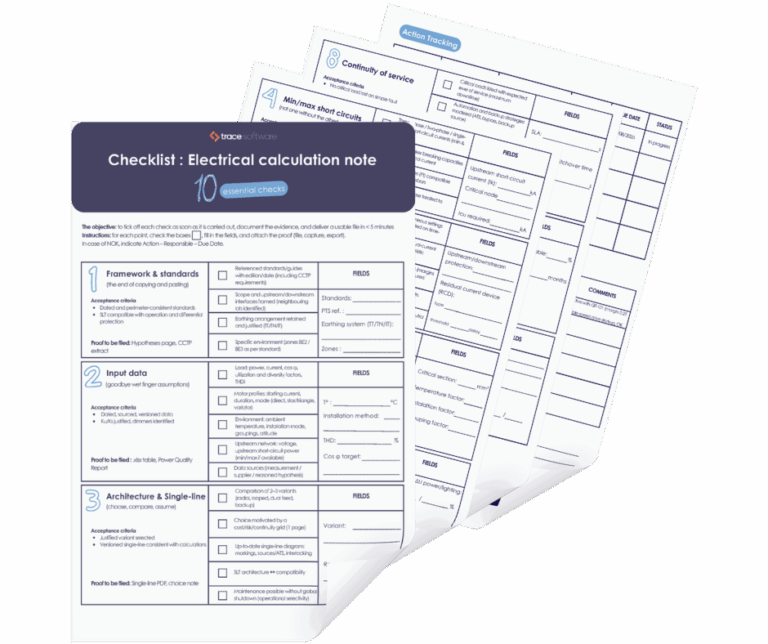
Your essential checklist!
Check each essential point for effective calculation.
Common mistakes to avoid
Reduce the calculation note to the sizing of the cables only
“Optimising the cable cross-section is enough“. This is a classic mistake. Without verification of the neutral regime, without control of the minimum and maximum short-circuit currents, without validation of selectivity and thermal stresses, the savings made at the time of purchase can later be transformed into untimely tripping and repeated interventions. The really relevant optimization considers the cable cross-section, the protection devices, the power quality and the operating conditions.
Neglecting operating conditions
Ambient temperature, installation method, circuit grouping, planned extension, corrosive environment, presence of sensitive users, operating hours, engine start-up cycles, harmonic rates, all this influences the dimensioning. The electrical calculation note must integrate these realities to avoid surprises.
Using an unsuitable or poorly configured tool
Generic or misconfigured software can produce attractive but unrepresentative results. You need a tool whose calculation models are proven, updated and cover the required normative depth, as well as a mastery of the parameters. This is precisely the interest of a dedicated solution like elec calc.
Insufficient documentation
An illegible or incomplete calculation note loses its value. The clarity of the deliverable, the traceability of hypotheses, the explanation of trade-offs and the structuring of appendices secure the project over time.
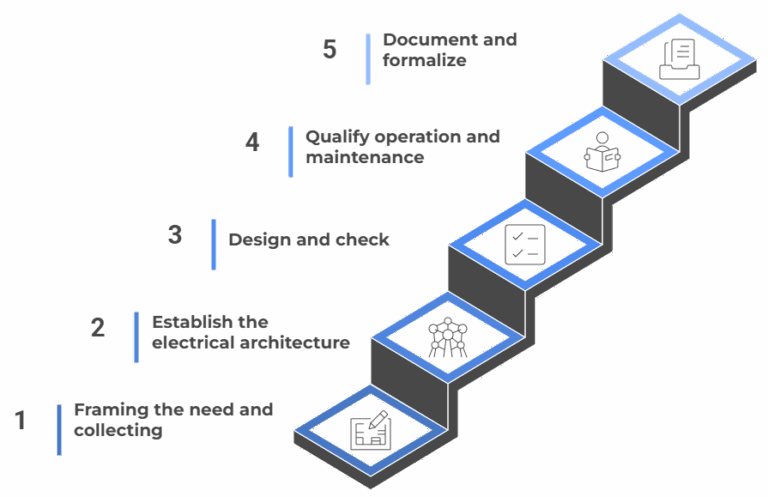
How to make a quality electrical calculation note in 5 steps
- Framing the need and collecting data : Define the scope, identify the costs, specify the usage profiles, identify the environmental constraints and availability requirements in order to avoid back and forth and establish a solid model.
- Establish the electrical architecture : The choice of architecture (radial, looped, dual power, backup sources, LV/MV) determines fault behavior, selectivity and costs; comparing several variants informs the decision.
- Design and check : We size conductors and protections, check all electrical stresses and the adequacy of the equipment, then we deal with coordination and selectivity to guarantee reliable protection without cascading trips. A good calculation note explains the choice of settings and their robustness in operation, not just the values chosen.
- Qualify operation and maintenance : The electrical calculation note must also be useful to the operator by highlighting the singular points, the instructions for use, the margins and limits to be monitored, because it is as much a design tool as a support for the life of the installation.
- Document and formalize : Structure the note with assumptions, schemas, and key results, and then archive and index the reference version to ensure timely and reliable access to information.
Why use a dedicated electrical calculation note software?
Faced with the increasing number of parameters to be controlled, the diversity of possible scenarios and the increasingly stringent normative requirements, producing a reliable electrical design note without a dedicated tool is a challenge.
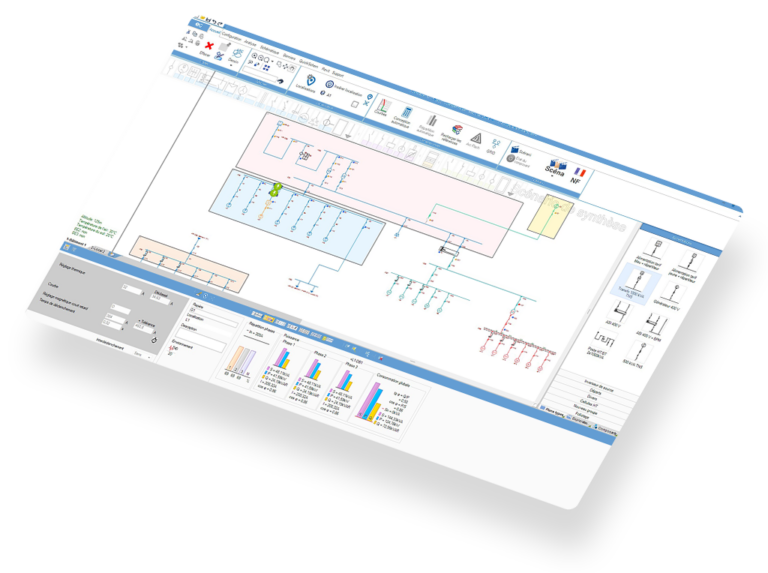
Specialized software then becomes essential. It allows you to accurately model architecture and loads, automate prescriptive checks, test different variants, and generate clear, actionable documentation. Real-time calculations and alerts for inconsistencies save a lot of time while increasing decision security.
The elec calc software is part of this logic. It offers intuitive modeling, takes into account installation conditions, manages selectivity and coordination of protections, and allows for easy reuse of models during extensions or updates. The objective is to make the production of electrical calculation notes simpler, more reliable and more adapted to the real needs of the field.

Discover how to speed up your studies and make your deliverables more reliable with elec calc
The 10 essential points to ensure security, compliance and performance (integrated checklist)
You can use the list below as a common thread in your study reviews. The downloadable PDF version offers checkboxes, formula reminders, and a comment space for internal audit.
- Normative compliance and scope
Have you identified the applicable standards and checked that the design note covers the entire scope of the project, including the planned interfaces and extensions? Compliance is not just about numbers; it also concerns the assumptions and limits of use.
- Inputs and Assumptions
Are the loads, their utilization and simultaneity factors, neutral regime, operating scenarios and environmental conditions clearly listed and justified? Without solid assumptions, the calculation loses its value.
- Sizing of conductors and protections
Are the sections, installation methods, groupings, temperatures, and associated protection devices sized and justified, with the necessary margins? Proper sizing protects both installation and availability.
- Voltage drops and power quality
Are voltage drops within project limits, at nominal speed and at engine start? Have the harmonic phenomena been evaluated and, if necessary, treated?
- Short-circuit currents and equipment resistance
Have the presumed short-circuit currents been calculated at all significant points and compared with the breaking capacities of the protections and the thermal stresses of the conductors? This verification is the key to security.
- Selectivity and coordination
Does the note document selectivity, temporal and differential, to avoid cascading triggers? Are the protection settings argued and gathered in a reference table for the operator?
- Service continuity and fault scenarios
Are continuity needs (critical loads, redundancy, backup sources) taken into account, with fault scenarios studied and mitigation measures documented? Resilience is conceived from the study.
- Operating Conditions and Maintenance
Temperature, ventilation, accessibility, environmental constraints, consignment procedures, frequency of tests, is all this anticipated and noted? The operator must find useful information for his routine in the calculation note.
- Documentation and traceability
Are the single-line diagrams, plans, bills of materials, protection settings, material references, hypotheses and variants studied collected and versioned? Traceability streamlines audits and developments.
- Scalability and margins
Have capacity margins and reservations been explicitly planned for future expansions? A small additional cost under study avoids costly requalification later.
Access the PDF checklist
It brings together the essential controls on one page and saves you time in proofreading.
Use cases
Scenario A : Section optimization only. Commissioning with start-up trips, excessive voltage drops at the end, adjustments reworked without an overview; Increased downtime and maintenance.
Scenario B : Full calculation note. Integrated engine profiles, worked selectivity, adjusted sections where necessary, adapted protections, planned reserves. Slightly higher initial cost but better availability, stability and overall cost at three years.
FAQ
Is the electrical calculation note mandatory?
Depending on the country and its regulations, there are different requirements regarding the calculation note and its content. In any case, having a note with the highest level of detail will always improve the quality of the project and facilitate its legalisation and/or approval by the competent authorities, as well as its reading and interpretation.
Who makes the electrical calculation note?
Design offices, qualified installers or in-house engineering departments with the skills, reliable data and the right tool.
How to produce a calculation note effectively?
Clear assumptions, accurate modeling, tooled normative verifications, structured and versioned deliverables.
Which software should I use for a calculation note?
A specialized solution, updated in a standard, offering real-time calculations and generation of deliverables, e.g. elec calc. This software is also referenced by the ELIE BT 2025 brand, a guarantee of reliability and recognition in the profession.
Conclusion
The electrical calculation note is a living document, at the service of the safety and performance of the installation. It begins before the choice of equipment and continues well after acceptance, in operation and during developments. Methodically worked on and supported by dedicated software, it becomes a project accelerator, a quality assurance and a lever for optimizing overall costs.
To structure your reviews and make your deliverables more reliable, adopt the 10-point checklist now. It fits on a page, reads in five minutes and saves you from costly oversights.
- Download the PDF checklist: 10 points to ensure safety, compliance and performance
- Discover the software: elec calc – electrical calculation note software
This article was written by:

Jérôme MULLIE
Technical Director - Trace Software
In addition to providing a complete calculation solution, we also want to share our expertise in electrical engineering with the players in the sector in order to support them in the design and operation of their installations.


