


 Technical
Introduction
Picture this: a smart factory, powered by AI and IoT, suddenly comes to a halt due to a split-second power outage. Critical data is lost. Production halts. Algorithms malfunction. In the landscape of Industry 4.0, where systems are hyper-connected and data-driven, power stability isn’t a luxury-it’s the backbone of the entire operation.
This is where the UPS (Uninterruptible Power Supply) steps in. It acts as the invisible yet essential safeguard, ensuring power continuity at all times.
In this new industrial age, where milliseconds count and downtime is unacceptable, the UPS isn’t just a device-it’s a strategic necessity.
Understanding Industry 4.0: The Data-Driven Revolution
Data: The Lifeblood of Smart Manufacturing
Industry 4.0 fuses advanced technologies like the Internet of Things (IoT), artificial intelligence, machine learning, and cyber-physical systems. All of these innovations rely on one common element: data.
Every smart sensor, cloud application, or automated machine needs to constantly process and transmit data. But without reliable power, data stops flowing. Systems crash. Automation fails.
The Industrial Data Centre: The New Heart of Operations
In Industry 4.0, Data Centres are no longer limited to the IT sector. They are the central hubs of smart factories, managing everything from real-time analytics to cloud-based software services.
To function effectively, these centres must offer uninterrupted uptime, with failure rates approaching zero.
This is precisely why power stability-and by extension, UPS systems-is mission-critical.
What Is a UPS and Why Does It Matter in 2025?
A Quick Technical Overview
A UPS is an electrical device that provides emergency power to a load when the main power source fails. It typically consists of batteries and power converters that instantly switch to backup mode in the event of an outage.
The conversion between AC and DC power is achieved using a combination of rectifiers/chargers and inverters to supply the appropriate voltage to connected devices. This ensures that the system can respond instantly and prevent any service disruption.

The key here is speed: the switchover is so fast that systems don’t even notice. No data is lost. No process interrupted.
Why UPS Systems Are Non-Negotiable
- Cybersecurity threats are rising: An increasing number of cyberattacks target electrical infrastructure. A planned power cut can lead to major damage if not protected.
- IoT devices are everywhere: Each device adds to the network’s complexity and vulnerability.
- Regulatory standards are stricter: Compliance with ISO 27001 and IIoT certifications demands near-zero tolerance for power disruptions.
Real-World Scenarios Where UPS Is Indispensable
Smart Manufacturing Plants
A short power cut on a robotic assembly line can cause unplanned shutdowns, mechanical failures, or recalibration issues. UPS systems keep things running until the power stabilises.
Industrial Data Centres
A single outage can corrupt terabytes of industrial analytics or customer data. UPS systems provide a critical buffer for backup systems to take over.
Automated Transport and Logistics
AGVs (Automated Guided Vehicles), autonomous drones, and smart warehouses depend on precise navigation systems. A power glitch could cause collisions or inventory loss.
Smart Integration with elec calc
Intuitive Design for Complex Systems
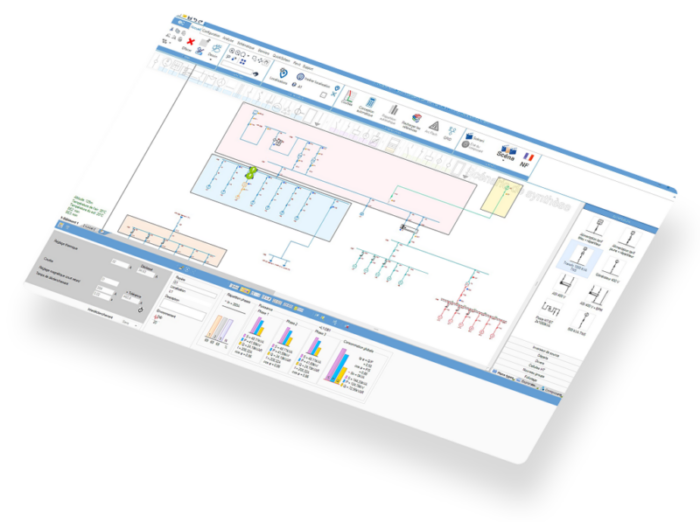
The elec calc software by Trace Software enables engineers to design UPS-backed systems with ease. It allows users to model UPS units as standalone components, complete with bypass and transformer stages.
Real-Time Calculations
The software automatically recalculates short-circuit currents, voltage drops, and harmonic levels as the design evolves-ensuring the system is always balanced and safe.
Ready-to-Use Manufacturer Catalogues
Built-in product libraries help users match their virtual UPS model with real-world commercial references, simplifying procurement and implementation.
UPS and Sustainability: A Smart Investment
Modern UPS systems are built for longevity, repairability, and modular expansion. They protect delicate electronics and reduce the wear and tear caused by unstable grids.
Some models even support energy storage strategies like V2G (Vehicle-to-Grid) and grid support, contributing to overall grid resilience.
Conclusion: Small Device, Huge Impact
In a world where downtime equals loss, the UPS becomes more than a backup. It becomes a guarantee of performance, continuity, and digital trust.
Adopting an intelligent UPS strategy, supported by advanced tools like elec calc, means your facility is not just protected-it’s optimised.
Ready to choose the right UPS for your project?
FAQ: UPS in Industry 4.0
What is a UPS?
A UPS (Uninterruptible Power Supply) is a backup system that keeps critical equipment running during power outages.
Why is a UPS essential in Industry 4.0?
Because any power failure can disrupt data flows, halt automation, and lead to significant financial losses.
How long does a UPS last?
Depending on the environment and usage, UPS systems generally last between 5 to 15 years.
How do I size a UPS for my facility?
You need to assess your critical load, desired autonomy, harmonic conditions, and power quality. Software like elec calc can automate this.
Can multiple UPS systems work together?
Yes. Modular UPS systems can be connected in parallel to scale capacity and add redundancy.
Are UPS systems compatible with renewable energy?
Absolutely. Many modern UPS systems can integrate with solar or wind power, making them ideal for smart industrial microgrids.
This article was written by:

Ricardo MARTIN
Technical expert - Trace Software
Ricardo Martin ensures the success of technical support in the international market. "We are proud to assist professionals in their daily challenges. Sharing our knowledge and experience, together with the close contact, is a key for them to reach their maximum efficiency".


