


 Technical
Summary
Agrivoltaics (agri-PV) makes it possible to reconcile solar electricity production and agricultural production on the same plot. Its main interest lies in the optimization of land, the security of agricultural incomes and the improvement of climate resilience.
In the United Kingdom, where the development of ground-mounted solar power is accelerating in a context of energy transition and enhanced energy security, agrivoltaics appears to be a solution that makes it possible to reconcile the production of renewable energy with the maintenance of agricultural uses. Its development is part of a regulatory framework based mainly on territorial planning and the local acceptability of projects.
Well designed, an agrivoltaic project becomes a sustainable and efficient asset. Poorly designed, it can encounter significant obstacles during the authorisation procedures.
Introduction
Developing a ground-mounted photovoltaic project is no longer limited to a technical approach based on production or connection. The central question is now that of land use.
In the United Kingdom, this issue is particularly sensitive due to limited land availability and the importance of preserving high-quality farmland, as well as landscape integration in planning decisions.
In a context marked by carbon neutrality objectives, rising energy needs and food security issues, projects must be part of a more demanding territorial balance, where agricultural production and energy production can no longer be thought of separately.
It is in this context that agrivoltaics is gradually establishing itself as a structuring response. It is no longer just a question of installing panels on an agricultural plot, but of designing systems capable of creating joint energy and agricultural value.
Not all photovoltaic projects developed in agricultural areas are therefore covered by agri-PV. And above all, not all of them generate real agricultural profits. In the British context, the demonstration of continued agricultural use becomes a key element in obtaining local authority approval.

Structuring a compliant agrivoltaic project from the outset
Access a complete set of specifications to secure your projects and avoid regulatory refusals.
Download the agrivoltaic specificationsAgrivoltaics: a response to land constraints and energy objectives
The development of ground-mounted photovoltaics is accelerating strongly in the United Kingdom, supported by national climate targets and the desire to reduce energy dependency.
This dynamic leads to increasing competition for land use. Agricultural land represents a significant part of the potential sites, but its conversion regularly gives rise to public debate.
Historically, UK solar projects have often been built on farmland of varying quality, subject to obtaining local planning permission. However, concerns about the loss of productive agricultural land are now increasing the demands for agricultural integration.
Agrivoltaics provides an answer to this problem by introducing a logic of dual land use. It makes it possible to overcome the opposition between agriculture and energy production by demonstrating that the two activities can coexist.
The challenge is no longer just to produce renewable energy, but to do so without compromising the agricultural vocation of rural areas.
What is agrivoltaics, concretely?
Agrivoltaics refers to a system in which a photovoltaic installation is installed on an agricultural plot, with the aim of making a sustainable contribution to agricultural activity.
In an agrivoltaic project, agricultural production remains the main activity. Electricity production is a complementary use, which must be integrated without degrading agricultural performance, and ideally improve it.
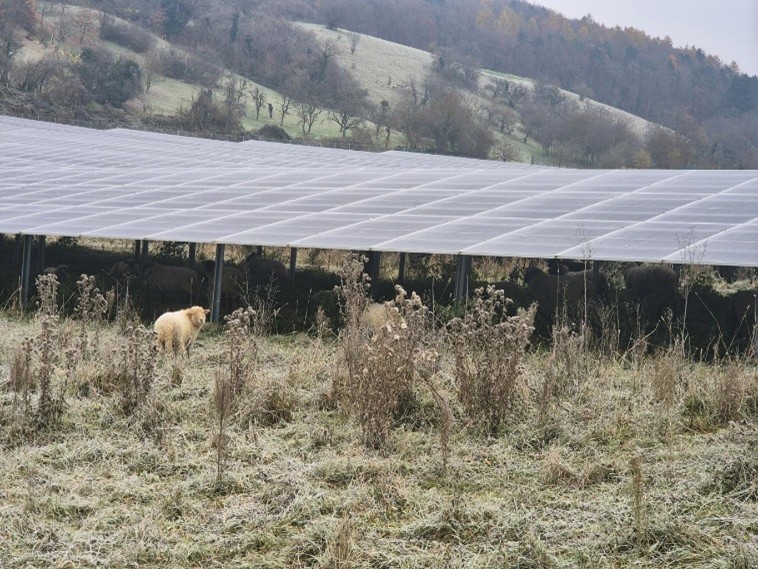
This logic is based on a principle of synergy. Depending on their design, the facilities can provide different services:
- Protection against certain climatic hazards,
- Sunlight management,
- Improvement of grazing conditions,
- Protecting livestock from extreme weather
Agrivoltaics therefore implies a functional interaction between agriculture and energy production, and not a simple cohabitation.
A regulatory framework based on territorial planning
Unlike France, the United Kingdom does not have a single legal definition of agrivoltaics. Projects are mainly evaluated within the framework of the local planning system.
Decisions are based in particular on:
- National Planning Policy Framework,
- Local urban development plans,
- Landscape and environmental impact assessment,
- The maintenance of agricultural use of the land.
Local authorities are particularly considering:
- The preservation of agricultural land,
- The reversibility of the installations,
- The visual and landscape impact,
- The continuity of agricultural activity.
The performance of a project is therefore not only measured in terms of energy production, but also in terms of territorial integration and local acceptability.
Why is there so much interest in agrivoltaics in the UK today?
Economic diversification for farms
Agrivoltaics offers farms a stable additional income, which is particularly relevant amid changing agricultural policies and market conditions.
Agrivoltaics can be a stable source of additional income, making it possible to secure the economy of farms while maintaining their agricultural activity.
A lever of acceptability for developers
Climate change is leading to an increase in extreme weather events in the UK, including periods of summer drought and heavy rainfall.
Agrivoltaic systems can help to:
- Protect the soil,
- Improve animal comfort,
- Stabilize certain agricultural productions.
However, the benefits remain highly dependent on the design of the project and the type of farm.
Limitations and key considerations
The complexity of the projects is higher than for a conventional photovoltaic power plant and requires close coordination between developers, farmers and local authorities.
Planning procedures can be long and uncertain, particularly because of landscape and community issues.
Investment costs are also higher due to the adaptations needed to maintain agricultural activity.
These elements imply a rigorous structuring of projects from the earliest phases.
How to make a successful agrivoltaic project
The success of an agrivoltaic project depends above all on the quality of its design.
A successful project is first thought out from the farm: its practices, its constraints and its operating cycles.
The circulation of agricultural machinery, the organization of the pasture, the height of the structures and the location of the rows directly influence the viability of the project.
Co-construction with the farmer therefore becomes essential from the outset.
Tools such as archelios PRO make it possible to structure the design by integrating energy simulation, 3D modeling and economic analysis in order to secure technical and financial decisions.
In the specific case of agrivoltaics, scenario analysis allows optimisation of both energy output and agricultural performance.
Avoid administrative rejections
A poorly structured project can be rejected or requalified. Download the specifications to secure each step.
Download the specificationsCase in point: cattle agrivoltaics in France
Example with a concrete case:
A 14.5 MWp cattle agrivoltaic project developed in France is a perfect illustration of the stakes.
Here, photovoltaics do not constrain agricultural activity. They are designed to complement it.
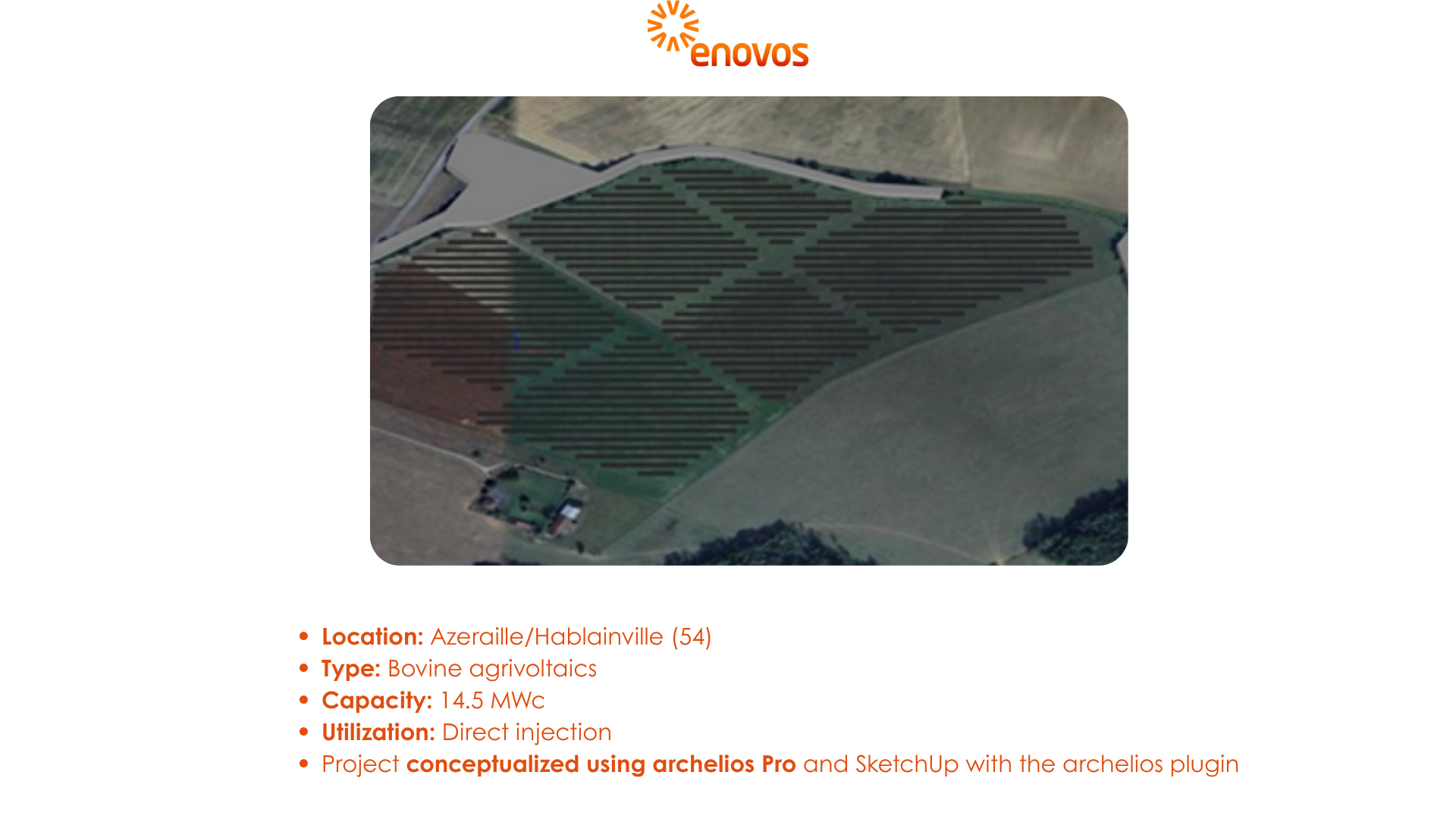
Access and movement are designed for both farm machinery and livestock. The installation of the panels takes into account the needs of the farm, integrating production constraints and the organisation of the plots.
The project is designed over the entire life of the installation, which is generally between 20 and 30 years. This involves anticipating changes in agricultural practices and ensuring that performance is maintained over time, in accordance with the agronomic monitoring obligations provided for by the regulations.
It is precisely this approach that makes it possible to secure the acceptability of the project, its profitability and its regulatory compliance.
It is exactly this type of approach that makes it possible to secure both:
- Acceptability
- Profitability
- Regulatory compliance
FAQ
Agrivoltaics consists of producing solar electricity on an agricultural plot while maintaining a sustainable agricultural activity.
Projects are regulated through local planning policies and must demonstrate continued agricultural use and benefits.
Yes, if it balances energy production, agricultural constraints and an economic model in the long term.
Conventional photovoltaics replace agricultural use. Agrivoltaics maintains it and must improve it.
The United Kingdom, France, Germany and Spain are among the developing markets.
The project must make a sustainable contribution to agricultural production and not degrade its performance.
Conclusion
Agrivoltaics marks an important evolution of ground-mounted photovoltaics in the United Kingdom. It is no longer just a question of producing renewable energy, but of designing projects capable of creating sustainable energy, agricultural and territorial value.
A successful agrivoltaic project is based on its ability to demonstrate its coherence from the design phase. Location, agricultural impacts, landscape integration and economic viability must be analysed together in order to secure the authorisation and sustainability of the project.
Tools such as archelios PRO allow modeling and analysing all project parameters from the start. In the British context, this approach is a key lever for designing high-performance, locally accepted and sustainable projects.
Sources


This article was written by:

Jérôme MULLIE
Technical Director - Trace Software
As well as providing a comprehensive calculation solution, we also aim to share our expertise in electrical engineering with professionals in the sector to assist them in the design and operation of their facilities.


