


 Technical
In 2025, storage is the key to transforming your solar kWh into economic value, whether you are a residential or C&I (tertiary and industrial) player. This article explains three possibilities, and guides you to the right architecture, sizing, and business model.
Essential definitions
Battery storage: an on-site physical system (batteries + inverter + control unit) that stores PV energy for later use or injection, shifts consumption, smooths peaks, enables price arbitrage, and can provide backup in case of grid outage.
Virtual battery (or virtual storage): a supplier offer where surplus PV generation is credited in kWh to a digital account and later returned according to contract terms. There is little to no hardware to buy, but the virtual battery does not offer backup in the event of a power cut.
BESS: “Turnkey” Battery Energy Storage System, just like battery storage, but typically includes specific management to provide services to the grid (reserves, arbitrage, congestion management).
Self-consumption: the share of PV production consumed directly on site.
Introduction: why now?
European solar production is exploding, implying a midday production peak, exceeding consumption needs as well as the capacity of our infrastructure. The consequences? Volatile prices, periods of negative pricing and significant curtailment. To address this issue, policymakers are limiting premiums and incentives for PV installations, while setting targets and a framework that is conducive to battery storage, capable of optimizing the use of solar energy and relieving our infrastructure. In 2024, Europe added ~22 GWh of BESS, for a ~61 GWh fleet (source: SolarPower Europe). Storage is becoming a key link in optimizing the technical and economic performance of its facilities, and capturing value.
Part A – Residential
Imagine your home equipped with 6 to 9 kWp on the roof. At noon, your meter runs backwards; at the end of the afternoon, your uses start again: cooking, heat pump , charging an electric vehicle. Without a strategy, part of your solar power at noon is sold off to the grid, and you buy your electricity at a much higher price in the evening. Storage is precisely used to put these kWh back in the right place at the right time.
Two ways to capture value
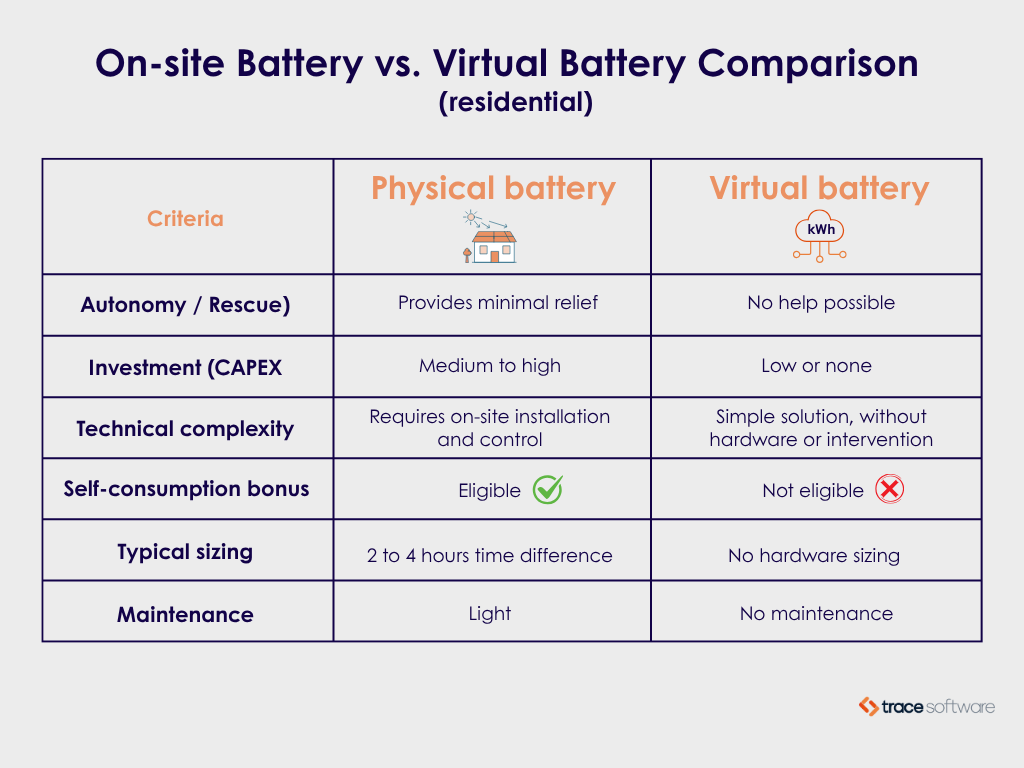
Battery storage: The midday surplus is stored and then moved to the consumption period.
The result: a better rate of self-consumption, a minimum possible backup for essential loads (box, lighting, refrigeration) and additional savings. The battery becomes a small “rhythm regulator” that makes the PV production stick to the life profile of the household.
Virtual storage: Typically without technical intervention, the surplus is credited in kWh to a digital wallet at a supplier and then returned later according to the rules of the contract. It’s practical to optimize the bill when autonomy is not a priority but CAPEX constraints are. Note in France: this mechanism does not entitle you to the self-consumption bonus. As the electrons are not actually stored on site, this solution does not provide backup in the event of a power cut.
Sizing without making a mistake
The right sizing remains sober: align the battery power with the tip of the home and adjust the energy to the useful time lag between noon and evening (often 2 to 4 hours). Avoid oversizing: a battery that is too large will charge poorly in winter, will tie up unnecessary capital and won’t add additional value. If you have off-peak hours, the control can charge at a low price and discharge at expensive times, combining a price advantage and solar.
How to decide quickly
If you are looking for local energy control and autonomy assurance, the battery is the right lever. If your priority is contract simplicity without CAPEX, virtual storage is a good solution. In the presence of marked off-peak hours, the battery maximizes economic interest by adding time arbitrage to solar.
Part B - Tertiary / C&I (Commercial & Industrial)
Imagine a tertiary site equipped with about 1 MWp of photovoltaics. In the middle of the day, your roofs and shades produce more than your uses, while peaks are present in the morning and late afternoon (HVAC reminders, processes, canteen, EV terminals).
Your objective is twofold: to increase the rate of self-consumption and to reduce power demands without making operation more complex.
What does on-premises storage change?
A battery system installed at the point of delivery becomes an energy buffer: it captures excess PV production in the middle of the day and releases it at useful times. In concrete terms, you combine time arbitrage (buying less in expensive hours), peak shaving, support for EV charging and preparation for possible local flexibility schemes. Experience in the field shows that such management accelerates the trajectory towards 60% self-consumption, an achievable and economically rational objective.
Sizing with sobriety
Align battery power with the peak(s) you want to shave and fix the power to the useful offset window (2 to 4 hours is often enough). Seasonal instructions avoid charging “at the wrong time”. The management of EVSE terminals and the implementation of a smart-charging strategy (staggered departure, current thresholds, prioritization) effectively completes the system.
Opening the door to the markets (cautiously)
In France, batteries have been certified on the primary reserve (or FCR, Frequency Containment Reserves) since 2017, and the secondary reserve, the aFRR (automatic Frequency Restoration Reserve) has been open since 19 June 2024 via a daily call for tenders (RTE). Access to these mechanisms requires real-time telemetry, a minimum of 1 MW of available capacity, availability commitments and, often, an aggregation contract.
The golden rule is simple: first serve your site, then recover the residual on the electrical system. This hierarchy protects your operation and secures the business model.
When to Prefer Virtual Storage
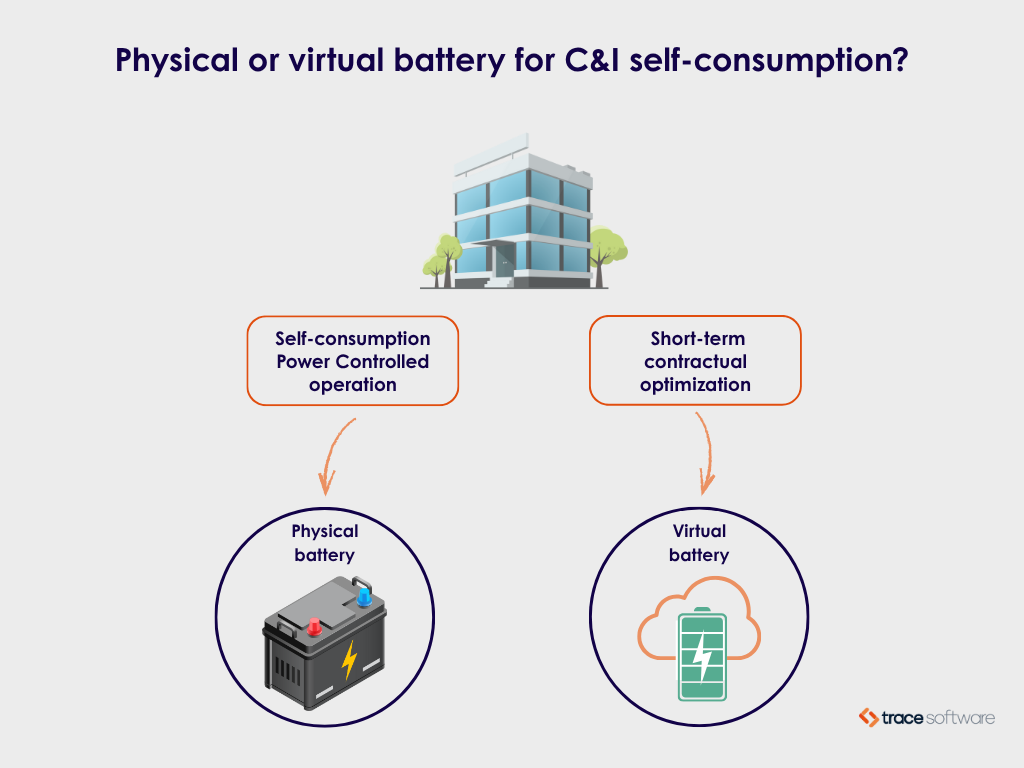
For the small tertiary sector with a subscribed power of less than 36 kVA, virtual storage can be a good option to optimize the bill without CAPEX or work, and the subscription costs can be amortized in OPEX. On the other hand, it does not reduce peaks, does not provide any assistance and control can be limited depending on the supplier chosen. It is relevant in the transitional phase, or for sites where continuity is not critical and where technical space is lacking.
Decide quickly, well
If your priorities are self-consumption, power and controlled operation, the on-site battery is essential. If the connection power allows it, and you are only aiming for short-term contractual optimization, the virtual can do the relay. In any case, start with a sober sizing, test different variants and lock in a clear order of priority between internal uses and possible network services.
Part C – Industries and large installations: the role of the BESS
Imagine your electro-intensive site: furnaces, compressors, pumps, fast loading ramps and quality instructions that do not tolerate hazards. PV covers midday production, but your peaks and load ramps occur at other times.. A BESS then becomes an operating asset that does two things at the same time. First, it is used to optimize your bill by increasing self-consumption, capping power demands and providing basic backup on critical uses. Secondly, it can be used as a tool to generate additional revenue when it is available, in particular on frequency reserves, via arbitrage and local congestion management.
What to put in place before
Before deploying a battery storage solution integrated into a photovoltaic power plant, several prerequisites must be put in place. Real-time telemetry and robust controllability are essential to manage setpoints, state of charge limits (SOCs), power ramps and capacity reservation. In addition, availability commitments must be respected depending on the mechanisms targeted, often through an aggregator. Finally, a clear governance of priorities is essential: the tool must first meet the needs of the site, before being able to allocate its margins to the markets. It should be kept in mind that each hour reserved for the network corresponds to a resource that is not available for internal use.

Sizing without exaggeration
- Power
- Energy
- Electrical diagram
- Piloting
The sizing of a storage system must be carried out rigorously, but without excess. The power must be defined according to the peak to be shaved and especially the ramps related to the site’s processes, whether they are start-ups or rapid variations. The energy capacity, on the other hand, must be aligned with the useful travel windows: in most cases, a duration of 1 to 4 hours per cycle is sufficient. The electrical diagram must include dedicated protections, adapted metering, the possibility of islanding to ensure a backup, as well as a safe and documented shutdown plan. Finally, management must be based on a clear hierarchy of services, the site as a priority, then the markets, with precise minimum and maximum SOC rules, instructions adapted to the seasons and effective supervision including an alert system.
Decide quickly, without sacrificing safety
Start with a priority use case (clipping + self-consumption), validate the annual value, and then gradually open up the system services. Keep operational margins for the unexpected (maintenance, network downtime) and integrate battery maintenance and replacement from the study stage.
Step-by-step sizing method
- The objective: to clarify whether we are aiming for self-consumption, capping, backup, flexibility (and the order of priority).
- Data: fine-resolution charging curves, subscribed power, usage profiles, EVSE terminals, tariffs.
- Charging stations: power on peak(s); energy over useful offset period (rechargeable all year round).
- Integration: protections, metering, telemetry if markets, operating instructions.
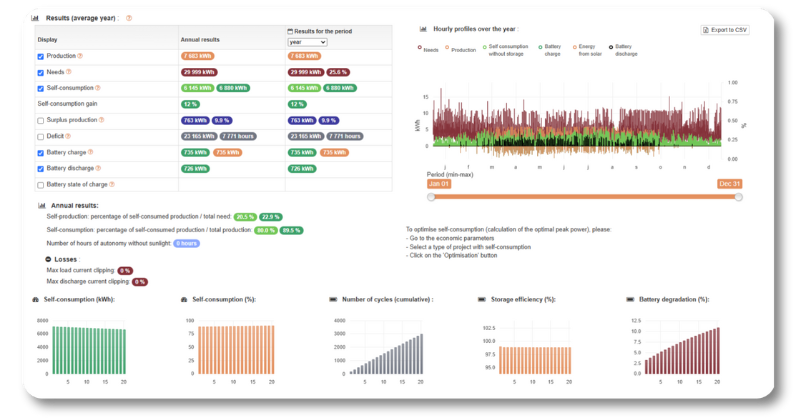
- Simulation : use professional software such as archelios pro, which allows you to simulate some variants of the project (import of 15-minute curves, battery scenarios, calculation of energy flows, export of economic analysis); choose the most robust simulation.
Save time with archelios PRO
- Import your PV production and consumption curves (CSV, smart meters);
- Test battery variants (power/energy, usage windows, network load, mini/max SOC);
- Compare self-consumption, storage gains, costs and profitability;
- Export a clear customizable report for customer decision.
2025 trends and points of vigilance
In 2025, several trends and points of vigilance deserve the attention of photovoltaic players integrating storage. BESS capacity continues to grow at a steady pace, but still falls short of the projected needs to support the solar boom. At the same time, the recurrence of episodes of high volatility and low or even negative prices reinforces the interest of batteries in energy arbitrage and capping. In addition, the networks are gradually opening up: in France, for example, the aFRR mechanism is now accessible to batteries (RTE), offering opportunities to eligible sites, provided that these requirements are integrated from the study phase. Finally, it should be remembered that the value of storage is based less on overcapacity that is rarely exploited than on reasoned sizing associated with robust management.
Conclusion
Storage is no longer an option: it is the link that stabilizes and monetizes your solar kWh.
In residential, choose the battery if you are aiming for autonomy and clipping; opt for virtual storage if your priority is to optimize the bill without work. In the tertiary/C&I sector, a battery becomes a performance lever (self-consumption + power terms) and prepares access to flexibility mechanisms.
For the industry, a BESS optimizes the site and can generate additional revenue (reserves, arbitrage), subject to clear management and governance.
- Next step: upload your 15-minute load curves (load + PV) and your constraints in archelios PRO. Simulate 2–3 scenarios with different storage formats and calculate the economic return. Finally, export a technical report, ready to be shared (self-consumption, power, ROI, assumptions).
This article was written by:

Carl WARD
Photovoltaic Product Manager - Trace Software
Carl WARD plays a key role in the development of our archelios range, dedicated to the design and optimisation of photovoltaic projects. "We are passionate about managing these solutions, and thanks to our expertise, we can help professionals to make solar energy more efficient, accessible and sustainable."


